Sunday, May 10, 2015

Technitium Bit Chat Released!

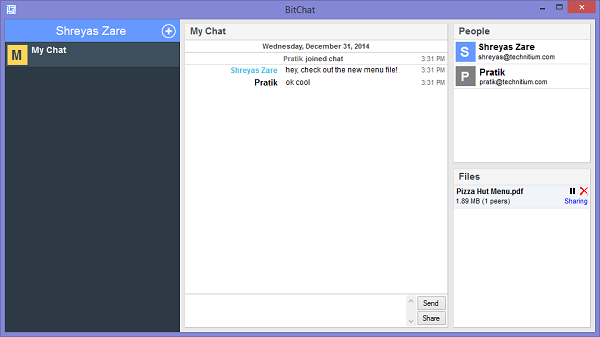
I am happy to announce the release of Technitium Bit Chat which is currently available for both Windows and Linux platforms. Version 2.1 (alpha) can be downloaded from here. You will need Mono Framework to run it on Linux.

Technitium Bit Chat
Technitium Bit Chat

Introduction

Technitium Bit Chat is a secure, peer-to-peer (p2p), open source instant messenger designed to provide end-to-end encryption. Primary aim of developing this instant messenger is to provide privacy which is achieved using strong cryptography. It can be used over Internet and private LAN networks for instant messaging and file transfer.

The architecture is designed keeping in mind the security principle that everybody is secure or no one is. There is no meta data generated when you use Bit Chat. The only thing that we know, is the email address of the user who registered for a digital certificate. The digital certificate tells that the email address was verified, which is similar, in concept, to any domain validated SSL certificate issued to a website.

Development is still in progress and new features will be made available as an when they are coded. The software has automatic update feature which will keep you updated with latest version available.

Read Frequently Asked Questions (FAQ)

Features

  • Provides end-to-end encryption using peer-to-peer technology, designed for privacy, delivered using strong cryptography.
  • Many-to-many group chat using peer-to-peer technology, so no servers involved in message delivery!
  • Can be used as a LAN chat instant messenger in your private LAN network the same way you can use it on the Internet.
  • Allows file transfer which works similar to torrents. File is split in parts and each peer participating the file sharing distributes different parts to each other. This leads to better network bandwidth utilization.
  • Each user has to perform a one-time profile registration. A profile digital certificate is issued to each user after email address verification. So, you can make sure that the person on the other side is really your friend by checking the profile email address.
  • Profile digital certificate is signed using RSA 4096bit key and SHA-256 hash algorithm.
  • Profile data is stored securely on your computer by encrypting with a profile password. So all your settings are encrypted using AES-256 encryption.
  • The peer-to-peer connection is completely encrypted using AES-256.
  • Automatic port forwarding using UPnP implemented for your home router/access point.
  • Automatic software update to keep you updated with the latest version.

The Concept

Since the software architecture is peer-to-peer, the usual concept of having a 'username' and 'password' for authentication and identification doesn't work here. There is no 'log in' or 'log out' here in that sense, due to the fact that there are no centralized servers involved to do the logging! Nobody knows if you left the chat group or you just went offline, unless of course, you tell them that yourself!

To understand this better, just imagine meeting with one or more friends at a place. You call up the people willing to meet and tell them a location and time. Everyone gets to the decided location, have fun and leave.

Bit Chat is exactly the same thing just over Internet. You email or message your friends and ask them to come on Bit Chat and give a chat group name. Everyone starts their client and join a chat with the decided name. The software does its peer-to-peer connectivity and everyone is connected to each other. Then you chat, transfer files, go offline and come back again to same chat group later or leave the chat group.

To make sure the identity of the peer in your group, you can check the email address of the peer. Each peer has to register for a profile certificate which is basically a digital certificate issued after email address verification. So, the email address in the profile certificate helps you make sure that you are chatting with the right person.

A chat group name is converted into an identifier which each peer in group tries to connect to using Bit-torrent trackers. Thus anyone who enters a chat group will get connected to other peers with the same chat group name. To avoid connecting to unintended people on the Internet, you can set an optional password or a shared secret to the chat group. The password will be used to generate the identifier for the chat group and only the people who enter a correct group name and password combination will be able to connect to each other. So, if you suddenly see some unknown people joining your group, don't panic, just leave current chat group and create another group with a different password.

The messenger connects each peer in a chat group in a mesh network topology, that is, a peer is connected to all other peers in that chat group to form a network. To find a peer on the Internet, Bit-torrent trackers are used and to find peers on local network, local peer discovery via UDP broadcast is used. If you are behind a router, you can enable UPnP feature in the router or access point and Bit Chat will do automatic port forwarding for you.

The network strength icon against each person's name indicates the current status of connectivity of that person. If the icon is green, it means, the peer is connected to all other peers in the group. An orange icon will indicate that the peer is not connected to someone in the group. You can click on any of the peers and check to whom they are connected to and to whom they are not.

It is important to note that, for Bit Chat to work successfully, at least one person in your chat group must be able to accept incoming TCP connection. If UPnP feature is available in your router/access point, automatic port forwarding will be performed. Otherwise, you will need to manually configure port forwarding. Bit Chat is designed to allow virtual connections to be made via another peer thus, just one peer able to accept incoming connection will make the entire chat group to work well.

In Windows, automatic firewall configuration feature will add entries for the application to accept incoming connections. For Linux, if there is any firewall configured, you will need to perform manual configuration to allow the software to accept incoming connections.

Features Planned

There are many features that are thought about to be implemented in Bit Chat however, following list gives some of the important features that are planned. There are no timelines for the implementation but they will be made available as soon as the implementation is completed.

  • NAT-PMP port mapping support.
  • Distributed Hash Tracking (DHT) support to rely less on torrent trackers.
  • One-to-one voice chat.
  • Emoticons support.
  • Alternate display name and profile picture support.
  • Store chat messages in the encrypted profile file.
  • Android mobile app with all the features.

Open Source

Technitium Bit Chat source code is available under GNU General Public Licence v3 on GitHub. The software code is made open source to increase confidence in the security that we intend to provide.

Alpha Version

Technitium Bit Chat current release is in alpha version. This means the software is not fully complete and will undergo major changes in its protocol or user interface design. There may be noticeable bugs which will be addressed with an automatic update. You are welcome to report any issues by sending an email to support@technitium.com.

Further, you may like to read the original concept in this old blog post.

Sunday, March 22, 2015

Technitium MAC Address Changer v6.0.6 Released

New update for Technitium MAC Address Changer is available for direct download and via Automatic Updates. You can download the complete setup from here. Separate update is available to download from here.

Official torrent for the complete setup can be downloaded from this magnet url.

The software will check for update automatically as per a fixed schedule. If you want the update before the automatic update triggers, just start the software, click on Help > Check For Software Updates menu to get it done instantly.

This update fixes minor bugs including an error that occurs while updating OUI file into local database from IEEE.ORG.

If you find any problem with the latest update just post a comment below. You may send screenshot(s) of the software if there is any critical issue to support (at) technitium (dot) com.

Tuesday, June 10, 2014

Fixing Wrong Original MAC Address in TMAC

If you believe TMAC is displaying incorrect original MAC address then you can fix this by using following command:

tmac -n <network-adapter-name> -ro

Where, <network-adapter-name> will be the name of your network adapter you wish to fix the issue for.

Checkout this link for more info on TMAC command line options.

Note: Make sure that you run CMD.exe as administrator. To do so, right click on the CMD icon and click 'Run as administrator' option. Also use the CD command first to change the directory to where TMAC is installed to be able to run the "tmac" command.

Sorting TMAC Installation Failure

In certain scenario, its possible that TMAC fails to install due to misconfiguration or missing components on your computer. This small post will describe how to resolve this issue.

You will first need to uninstall TMAC completely from your system if it got partially installed. Check files in the installation folder that you can find under Program Files (x86) folder and delete them. You then have to find and delete following files from your computer:

MSCHRT20.OCX
MSCOMCTL.OCX
TABCTL32.OCX

After deleting above files, run the TMAC installer again. The above method should fix the installation issue.

Saturday, December 21, 2013

Technitium.com Listed In Nmap's 'Icons of the Web' Project!

The Nmap Project released the 'Icons of the Web' project, which is a 5 gigapixel image containing favicon of popular websites (as ranked by Alexa).

I am happy to announce that Technitium.com is listed as a popular favicon in the 5 gigapixel image!

The icons are scaled in the image as per each site's monthly reach (popularity).You can have a look at the image here: http://nmap.org/favicon/?search=technitium.com

The project is an update to a similar project Nmap had performed in 2010. It was very popular and was mentioned in the New York Times and also got its place in Guinness Book of World Records.

Thursday, October 31, 2013

Technitium.com Hosting Down Temporarily [Updated]

Technitium.com is down due to issue at web hosting service provider end. The site will be made working as soon as new web hosting provider is selected.

Mean while you can download Technitium MAC Address Changer via Torrent or via Download.com

Will update the status on this soon.

Update:
Website is up and running with exception to file downloads. You can download the latest version from Download.com.

Sunday, October 20, 2013

Technitium MAC Address Changer v6.0.5 Released

New update for Technitium MAC Address Changer is available for direct download and via Automatic Updates. You can download the complete setup from here. Separate update is available to download from here.

Official torrent for the complete setup can be downloaded from here.

The software will check for update automatically as per a fixed schedule. If you want the update before the automatic update triggers, just start the software, click on Help > Check For Software Updates menu to get it done instantly.

This update fixes minor bugs including an error that occurs while updating OUI file into local database from IEEE.ORG.

If you find any problem with the latest update just post a comment below. You may send screenshot(s) of the software if there is any critical issue to support (at) technitium (dot) com.

Sunday, July 14, 2013

Technitium MAC Address Changer v6.0.4 Released

New update for Technitium MAC Address Changer is available for direct download and via Automatic Updates. You can download the complete setup from here. Separate update is available to download from here.

Official torrent for the complete setup can be downloaded from here.

The software will check for update automatically as per a fixed schedule. If you want the update before the automatic update triggers, just start the software, click on Help > Check For Software Updates menu to get it done instantly.

This update fixes minor bugs including an error that occurs while updating OUI file into local database from IEEE.ORG.

If you find any problem with the latest update just post a comment below. You may send screenshot(s) of the software if there is any critical issue to support (at) technitium (dot) com.

Tuesday, January 8, 2013

TMAC Crosses 1 Million Downloads On Download.com

Technitium MAC Address Changer (TMAC) crossed 1 million downloads on C|NET Download.com this week!

TMAC 1 Million Downloads

Sunday, September 2, 2012

Privacy And The Internet

There have been a lot of queries about MAC address and privacy on blog comments as well as in emails that I get from many users of TMAC. Reading this post should clear most queries that you have.

MAC Address & Privacy
A website on Internet cannot find your MAC address by any means. Your MAC address stays in the local network you are connected to (like LAN) and so technically only a website hosted on the same LAN network can find the visitor's MAC address.

So changing MAC address would give you privacy only at local network level. Nobody will be able to track your presence on the wifi networks that you connect to with a new MAC address being used every time.

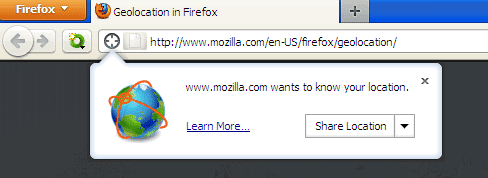
This Website Wants To Know Your Location!


One thing you must note that MAC address of your wifi access point or any other access point that is in your range will be disclosed when your web browser asks to share your location information and you click Share Location.

A web browser will compile a list of all the wifi hotspots in range and read their BSSID (MAC Address of station in an Access Point) with the signal strength and send it over to the website asking for it. The website uses a database of known MAC addresses with their location, combined with your IP address and try to figure out your location based on the signal strength [1][2]. In popular/commercial places the location can be as accurate as 25 meters. You can read more about it in this earlier post.

IP Address Based Location Mapping
IP address is commonly used to find the visitors location. Its pretty straight forward for a website to find a visitor's IP address. Using commercially available databases that map IP address to location, websites can provide region specific services to the visitors or just compile stats for visitor traffic analysis. The database can provide location up to the City the visitor is from. The database can be wrong at times due to IP address blocks being reassigned to another location but in most case, the country can be reliably identified.

If you are more paranoid about your IP address being disclosed, you can use Tor. Tor can be painfully slow at times but it does provide a level of anonymity for free. If you have some cash at hand, you can go for Virtual Private Network (VPN) services. These services will carry all your Internet data through their own network such that your IP address hides behind their data center IP address.

How Are You Being Tracked?
Most common way of tracking users is by storing identification data on user's computer known as Cookies. Web browser accept and store cookies that any website sends back. Cookies can easily be deleted with most web browsers. You can configure your web browser to clear cookies when the browser closes.

Cookies being easy to delete, websites and advertisement networks found new ways to track users. With most Internet connected computers having Adobe Flash installed, it became a new way to restore the deleted cookies. Adobe Flash Player allows to store cookies which cannot be deleted by clearing browser cookies. Users can however delete flash cookies manually by using Flash Player's Website Storage Settings Panel. Obviously, deleting flash cookies is difficult and most users are not even aware of the existence of a separate flash cookie.

Another way is by means of HTTP ETag. ETag was designed to enable smart web caching but can easily be used to track visitors. Each web resource (images, html etc) that browser stored in its cache can be identified by website supplied ETag. The only way to get rid of this is to clear your browser cache just like you clear cookies.

How Do I Protect My Privacy?
I would recommend you to use Firefox web browser and install following add-ons:
1. Better Privacy - It clears flash cookies when browser closes.
2. Certificate Patrol - It can prevent a very rare man in the middle attack on HTTPS websites.
3. HTTPS-Everywhere - It will add "https" automatically to URLs that you enter in browser forcing browser to use HTTPS even when you forget to enter proper https URL (works for popular websites only).
4. NoScript - Recommended only for advance users. It will block javascripts/flash from unauthorized websites. You can decide which sites can use javascript/flash easily.

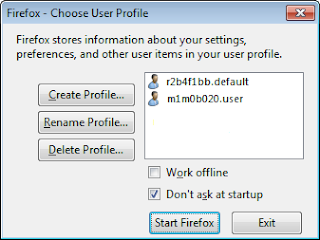
You can even use Firefox Profile feature. Its possible to create multiple "profiles" in Firefox, each profile being completely separate, having its own cache, cookies, history, add-ons etc. To do so, just go to Run (Start > Run or press Win+R) and enter firefox -p -no-remote and you will see a profile manager window. It can be very convenient to create a shortcut with the mentioned command line parameters for use every time.


Note that for each profile you create, you will need to install all the add-ons mentioned above separately. Using separate profiles, its possible to log in into different Google accounts in same browser without linking them together.

References:
1. Location-Aware Browsing - Mozilla Firefox
2. Location sharing - Google Chrome

Edit:
Read more about Ad networks tracking stats. You are always being tracked (stalked) by multiple Ad networks!